

Breathalyzer refusal in New York is the act of declining a chemical breath test during a DWI traffic stop, and it triggers automatic civil and criminal penalties under state law. Many drivers believe refusing the test gives them an advantage in court - but New York's implied consent law makes that calculation far more complicated than it appears.
This guide focuses specifically on the legal, administrative, and practical consequences of breathalyzer refusal for drivers stopped in New York State.
Key Definition: New York's implied consent law (Vehicle and Traffic Law Section 1194) means that by driving on a public road, you have already agreed to submit to a chemical test if lawfully stopped on suspicion of DWI.
The most common mistake we see is drivers assuming the refusal eliminates the case against them. It doesn't. What it does is add a separate, standalone legal problem on top of whatever DWI charge the officer pursues anyway.
What Breathalyzer Refusal Actually Triggers Under New York Law
New York treats refusal as its own offense, separate from DWI. The moment you say no to the test, two parallel processes start running simultaneously.
Refusal Revocation: An automatic license revocation issued by the DMV, completely independent of any criminal court outcome.
Refusal Hearing: A DMV administrative hearing held within 15 days of your arraignment, where an ALJ (Administrative Law Judge) decides whether the refusal was lawful and knowing.
According to the New York Courts system, these civil DMV proceedings operate on a separate track from criminal court. Winning your DWI case in criminal court does NOT automatically restore your license if the DMV finds the refusal was valid.
Thinking about this for your situation? Let's talk. Contact us for a free consultation with no pressure and straight answers about where you stand.
The Financial and License Penalties Broken Down
| Penalty Type | First Refusal (2025) | Second Refusal Within 5 Years |
|---|---|---|
| Civil Penalty (DMV Fine) | $500 | $750 |
| License Revocation | Minimum 1 year | Minimum 18 months |
| Annual Driver Responsibility Assessment | $250/year for 3 years | $250/year for 3 years |
| Refusal Used at Trial | Yes - as evidence of consciousness of guilt | Yes |
That driver responsibility assessment alone adds $750 over three years, on top of the $500 civil fine. And none of this touches the criminal fines, surcharges, or legal fees tied to the underlying DWI charge.
Refusal vs. Taking the Test: Which Approach Actually Works?
Where refusal succeeds: It removes one specific piece of numeric evidence - your BAC reading - from the prosecution's case. It can create reasonable doubt if the officer lacks other strong evidence of intoxication.
Where refusal fails: Prosecutors can still use field sobriety test results, officer observations, dashcam footage, and the refusal itself as evidence. The mandatory revocation period is often longer than a DWI suspension would be for a first offense.
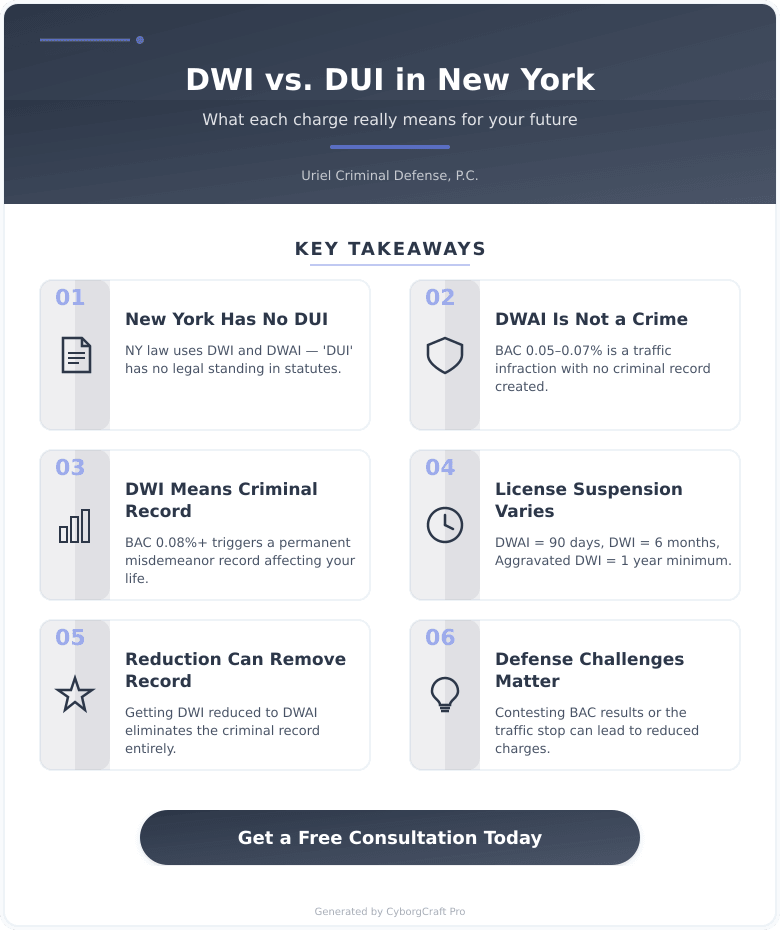
Where taking the test succeeds: If your BAC is close to or under 0.08%, the test can actually help your defense. You keep your license pending case outcome and avoid the automatic civil penalty.
Where taking the test fails: A BAC of 0.18% or higher triggers aggravated DWI charges with steeper penalties. A high reading gives prosecutors solid numerical evidence.
The verdict: Refusal is not a reliable defense strategy in New York. The automatic revocation, civil fine, and evidentiary use of the refusal create serious independent consequences. Whether refusal makes sense depends heavily on your specific circumstances - which is exactly why you need an attorney before the DMV hearing clock runs out.
Your Breathalyzer Refusal Action Plan
- Step 1 - Secure the arraignment date: Your DMV refusal hearing must be requested within 15 days of arraignment. Missing this window forfeits your right to contest the revocation.
- Step 2 - Hire a criminal defense attorney immediately: You need someone who can challenge both the DMV proceeding and the criminal charge simultaneously. These are different forums with different rules.
- Step 3 - Document everything you remember: Write down what the officer said, the sequence of events, any field sobriety tests performed, and the exact wording of the refusal request. Details fade fast.
- Step 4 - Check CDL or professional license exposure: Commercial drivers face disqualification. Certain licensed professionals in New York face additional reporting requirements to their licensing boards.
- Step 5 - Explore conditional license eligibility: Even during a refusal revocation, some drivers qualify for a conditional license through the DMV Drinking Driver Program. Your attorney can clarify whether you qualify.
Documents and Information to Gather Before Your Consultation
- ☐ Copy of your traffic ticket or desk appearance ticket
- ☐ Arraignment date and location
- ☐ DMV hearing notice if already received
- ☐ Your driver's license number and current status
- ☐ Any prior DWI or traffic violations on your record
- ☐ Notes on what happened during the stop
- ☐ Contact information for any witnesses
Research from the National Highway Traffic Safety Administration has examined refusal patterns in states with implied consent laws. New York's penalties are specifically designed to make refusal a less appealing option.
Key Takeaways for New York Drivers in 2025
- Refusal is not a free pass - it creates automatic penalties separate from any DWI charge
- The DMV clock starts immediately - you have 15 days from arraignment to request a refusal hearing
- Civil and criminal cases run in parallel - winning one does not automatically resolve the other
- Refusal can be used against you at trial - prosecutors present it as consciousness of guilt
- A conditional license may still be available - even during the revocation period in some cases
At Uriel Criminal Defense, P.C., we handle criminal defense cases throughout NYC and the surrounding areas, including Brooklyn and all five boroughs. If you're facing a breathalyzer refusal situation, the window to act is narrow. Our office at 540 Court Street in Brooklyn is available 24/7 for emergencies at (833) 733-4448.
Frequently Asked Questions
Does refusing a breathalyzer mean I won't get a DWI charge in New York?
No - refusing the breathalyzer does not prevent a DWI charge in New York. Officers can still arrest you based on field sobriety tests, erratic driving, and their observations. The refusal simply removes one piece of evidence while creating a separate set of civil penalties.
How long is my license revoked if I refuse the breathalyzer?
A first-time refusal results in a minimum one-year license revocation under New York law (2025). A second refusal within five years carries an 18-month minimum revocation, and the DMV civil fine increases to $750.
Can the refusal be used against me in court?
Yes - prosecutors in New York can present your refusal to the jury as evidence of consciousness of guilt. Judges instruct juries that they may, but are not required to, draw a negative inference from the refusal.
What happens at the DMV refusal hearing?
An Administrative Law Judge determines whether the stop was lawful, whether the refusal warning was properly given, and whether your refusal was knowing and voluntary. If you lose, the revocation stands regardless of your criminal case outcome. An attorney can challenge any of these elements.
Is there any way to keep driving after a refusal revocation?
Some drivers qualify for a conditional license through the New York DMV Drinking Driver Program, even during a refusal revocation. Eligibility depends on your prior record, the specific circumstances of the stop, and your completion of the program requirements.
How much does a breathalyzer refusal cost in total?
The direct DMV costs alone include a $500 civil fine plus $250 per year for three years in driver responsibility assessments, totaling $1,250 before attorney fees or criminal fines. Lost income from license suspension, increased insurance rates, and potential criminal penalties can push the total cost significantly higher.
Should I handle the DMV refusal hearing myself?
Handling a refusal hearing without an attorney significantly reduces your chances of a favorable outcome. The hearing involves specific procedural challenges to the stop, the warning given, and the refusal itself - areas where legal knowledge makes a measurable difference.
Your Next Step if You've Already Refused
Here's what matters most right now: the 15-day window to request your DMV hearing is already running. That deadline does not wait. A refusal that goes uncontested becomes an automatic revocation with no recourse.
Current best practices in 2025 show that drivers who retain defense counsel before the DMV hearing have a meaningfully better chance of challenging the revocation and building a parallel defense strategy for the criminal case.
Ready to protect your license and your record? Contact us today for a free consultation. Call (833) 733-4448 any time - including nights and weekends for emergencies. For a full overview of how we approach criminal defense cases, visit our services page.
Disclaimer: This content is for general informational purposes only and does not constitute legal advice. Reading this post does not create an attorney-client relationship. Consult a licensed New York attorney about your specific situation.