

This guide focuses specifically on what New York gun charges actually mean for you, how the prosecution builds its case, and what your real options are.
Criminal Possession of a Weapon Definition: Under New York Penal Law, criminal possession of a weapon is the unlawful possession of a firearm, knife, or other prohibited weapon, classified in degrees based on circumstances and criminal history.
New York enforces some of the toughest gun laws in the country. According to the New York State Division of Criminal Justice Services, firearms offenses in NYC are prosecuted at the state level, and illegal gun possession is treated as a serious criminal matter across all five boroughs. If you're facing a weapons charge right now, the decisions you make in the next few days matter enormously.
Why New York Gun Charges Hit Differently Than Other States
Most states treat gun possession as a misdemeanor for first offenses. New York does not. Even simple possession of an unlicensed loaded handgun in a public place is a Class C felony under Penal Law Section 265.02. That means mandatory prison time is on the table from the start.
Compare that to neighboring states and the gap is stark.
| State | Unlicensed Handgun Possession | Mandatory Minimum | License Required |
|---|---|---|---|
| New York | Class C Felony (loaded) | 3.5 years (with prior) | Yes - very restrictive |
| New Jersey | 2nd Degree Crime | Up to 10 years | Yes - restrictive |
| Pennsylvania | 1st Degree Misdemeanor | No mandatory minimum | License to carry required |
| Connecticut | Class D Felony | No mandatory minimum | Permit required |
| Massachusetts | Felony | 18 months | License to carry required |
New York's approach is aggressive by design. The state legislature built mandatory sentences directly into the statute, which limits what even a sympathetic judge can do.
The Different Charges You Might Be Facing
Not every weapons charge is the same. Here's what the degrees actually mean in plain terms:
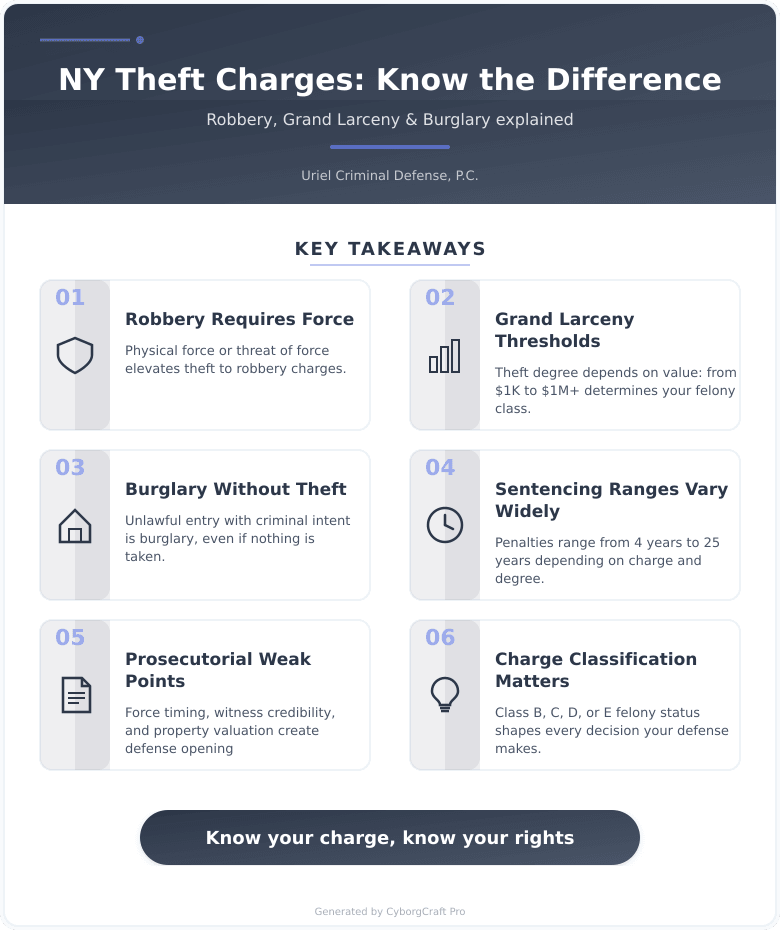
Criminal Possession of a Weapon in the 4th Degree (Class A Misdemeanor): Possession of certain weapons including switchblades or a firearm without prior conviction. This is the least serious weapons charge but still carries up to one year in jail.
Criminal Possession of a Weapon in the 3rd Degree (Class D Felony): Possession of an unlicensed loaded firearm outside your home or business, or possession with a prior conviction. Up to 7 years in prison.
Criminal Possession of a Weapon in the 2nd Degree (Class C Felony): Possession of a loaded, operable firearm with intent to use against another person, or possession of certain assault-style weapons. Mandatory minimum of 3.5 years; up to 15 years.
Criminal Possession of a Weapon in the 1st Degree (Class B Felony): Possession of ten or more firearms. Up to 25 years in prison.
The most common charge people face in NYC is second or third degree possession. And prosecutors here do not go easy on these cases.
Federal vs. State Gun Charges: Which One Applies?
Where state charges succeed: New York state handles the vast majority of gun arrests in the five boroughs. State courts process these cases quickly, and the DA's office has well-established protocols for firearms prosecutions.
Where state charges fail to capture severity: State charges alone may not reflect trafficking, organized crime involvement, or interstate transport of weapons.
Where federal charges succeed: Federal prosecutors step in when a firearm crossed state lines, when the defendant has prior felony convictions (18 U.S.C. Section 922(g)), or when the arrest connects to a federal investigation.
Where federal charges create bigger problems: Federal mandatory minimums under the Armed Career Criminal Act can mean 15 years to life with no parole in the federal system.
The verdict: If your case stays in state court, you have more options for negotiation. If it gets picked up federally, you need aggressive legal representation immediately. Either way, the time to act is now.
Thinking about your specific situation? Contact us for a free consultation. We'll tell you exactly what you're looking at - no pressure.
Your Gun Charge Action Plan
- Step 1 - Say nothing after arrest: Invoke your right to remain silent immediately. Anything you say will be used to build the prosecution's case. Ask for an attorney before answering any questions.
- Step 2 - Document everything you remember: Write down exactly where you were, who was present, what officers said, and how the firearm was discovered. Details fade fast and your attorney needs them.
- Step 3 - Secure legal representation before arraignment: Arraignment happens within 24-48 hours of arrest. Bail arguments happen there. Having an attorney present can mean the difference between going home or waiting in Rikers.
- Step 4 - Preserve any video or witness evidence: NYC has cameras everywhere. Surveillance footage gets overwritten within days. Your attorney can move to preserve it - but only if retained quickly.
- Step 5 - Understand your charge and its elements: Every criminal charge has specific elements the prosecution must prove. Knowing what they need to establish tells you where the defense opportunities are.
What Prosecutors in NYC Actually Look For
The most common mistake people make is assuming the charge will be reduced automatically or that a first offense means probation. That's not how NYC gun cases work.
- Prosecutors will check your prior record immediately - any prior felony changes your exposure dramatically
- They will look at where you were arrested - school zones and public transit increase penalties
- They will examine whether the weapon was loaded and operable
- They will investigate whether any other crimes occurred with the weapon
- They will review how the weapon was recovered and whether Fourth Amendment issues exist
Recent data shows that NYC prosecutors secured felony convictions in over 70% of firearms cases that went to trial in 2024. The cases that resolved favorably almost always involved early legal intervention and a close look at how evidence was obtained.
According to the NYC Mayor's Office of Criminal Justice, firearm-related arrests in the city remained a top enforcement priority through 2024 and into 2025.
What to Gather Before Your Consultation
- ☐ Arrest paperwork and any summons or desk appearance ticket you received
- ☐ Names and contact info for any witnesses present during the arrest
- ☐ Location details - address, building, was it your home or vehicle
- ☐ Any documentation of legal ownership or prior license applications
- ☐ Prior criminal history if any - your attorney needs to know before the DA does
Key Takeaways for Anyone Facing a Weapons Charge in 2025
- Mandatory minimums are real - judges have limited discretion once certain charges are filed
- The charge degree matters enormously - even one degree lower can mean years less in sentencing exposure
- Evidence suppression is often the strongest defense - illegal stops and searches happen, and those challenges can end a case
- Federal involvement changes everything - know early whether federal prosecutors are interested in your case
- Early representation gives you options - the arraignment stage sets the tone for the entire case
Frequently Asked Questions
What is the mandatory minimum sentence for a gun charge in New York City?
For a Class C felony gun charge with a prior felony conviction, the mandatory minimum is 3.5 years in state prison. Without a prior felony, judges have more discretion, but prosecutors in NYC routinely seek prison sentences even for first-time offenders on loaded firearm charges.
Can a gun charge in NYC be reduced or dismissed?
Yes, reduction or dismissal is possible but depends heavily on how the weapon was obtained by police and the specific facts of your case. Successful Fourth Amendment challenges - arguing the stop or search was unlawful - can result in evidence suppression and dismissal. An experienced attorney will review arrest records immediately for these issues.
Does having a license from another state protect me in New York?
No - New York does not recognize concealed carry permits from other states. Carrying a loaded handgun in NYC with an out-of-state license is still a felony under state law. This surprises many people who travel from states with more permissive carry laws.
How long does a gun case take in NYC criminal court?
Most felony gun cases in New York City take between six months and two years to resolve depending on the borough, court backlog, and whether the case goes to trial. Cases involving plea negotiations may resolve faster; contested cases with suppression hearings take longer.
What happens at arraignment for a gun charge?
At arraignment, you'll hear the formal charges, enter a plea, and the judge will rule on bail. For felony gun charges, prosecutors typically request significant bail or remand. Having legal representation at arraignment is critical because this is your first opportunity to argue for release.
Can I get a gun charge expunged in New York?
New York's sealing and expungement laws are limited, and felony gun convictions are generally not eligible for sealing under current 2025 law. Some misdemeanor convictions may qualify for sealing after ten years with a clean record. An attorney can review your specific record and eligibility.
Your Next Step Starts Here
Gun charges in New York City move fast. The prosecution builds its case from the moment of arrest, and every day without legal representation is a day they work without opposition.
At Uriel Criminal Defense, P.C., we handle criminal defense cases across New York City and surrounding areas, including clients in Brooklyn, Queens, the Bronx, Manhattan, and Staten Island. Our office at 540 Court Street in Brooklyn is ready to take your call around the clock because we know emergencies don't follow business hours.
Ready to get real answers about your case? Contact us today for a free consultation. Call us at 833-733-4448. The sooner we talk, the more options you have.