

This guide focuses specifically on how orders of protection work in Brooklyn, what they legally restrict, how long they remain in effect, and what options exist for challenging or modifying them.
If you're currently subject to an order of protection, or you've just been served with one, the details matter enormously. The restrictions aren't always obvious from the paperwork alone, and the consequences of getting it wrong range from arrest to a permanent criminal record.
What an Order of Protection Actually Restricts
Order of protection definition: A legal order issued by a New York court that prohibits a named individual from contacting, harassing, threatening, or approaching the protected party, and may also restrict where that individual can go or live.
Brooklyn courts issue two main types. The first is a full stay-away order, which prohibits any contact whatsoever - phone calls, texts, emails, social media messages, and physical proximity. The second is a limited order, sometimes called a refrain order, which allows contact but prohibits specific behaviors like harassment or threats.
Here's what often surprises people: a full stay-away order means exactly that. If your shared apartment is listed in the order, you may not be able to return home, even to collect belongings, without risking arrest. Courts in Kings County (Brooklyn) take violations seriously. According to the New York State Unified Court System, orders of protection are enforced statewide and can be honored across state lines under federal law.
Common restrictions in a Brooklyn order of protection include:
- No physical contact of any kind
- No electronic or written communication
- Staying a specified distance from the protected party's home, workplace, or school
- No contact through third parties
- Surrendering any firearms or licenses to possess firearms
- No entry into a shared residence
The most common mistake we see is respondents believing the protected party can "undo" the order simply by reaching out or saying it's okay. They cannot. Only the court can modify or vacate an order of protection.
How Long an Order of Protection Lasts in New York
Duration depends on what type of proceeding generated the order and what stage of the case it's issued at.
| Order Type | Typical Duration | Issued By | Best For |
|---|---|---|---|
| Temporary Order of Protection (TOP) | Until next court date or case resolution | Criminal or Family Court | Immediate protection during active proceedings |
| Final Order - Misdemeanor | Up to 5 years under amended NY CPL 530.12(5). | Criminal Court | Post-conviction or plea disposition |
| Final Order - Felony | Up to 8 years under amended NY CPL 530.12(5). | Supreme or Criminal Court | More serious criminal matters |
| Family Court Order | Up to 2 years, renewable | Brooklyn Family Court | Domestic matters without criminal charges |
| Extended Order (aggravated circumstances) | Up to 5 years from Family Court | Family Court | Repeat violations or serious harm |
Under current New York law, a final order issued following a felony conviction can run for up to eight years. Extensions are possible if the protected party applies and demonstrates continued need. The order doesn't expire quietly - it stays in effect until a court formally ends it.
Thinking about this for your situation? Let's talk. Contact us for a free consultation and straight answers about your specific order.
Fighting vs. Accepting an Order of Protection: Which Approach Works?
Challenging the Order vs. Accepting the Conditions - What to Weigh
Where challenging the order succeeds: If the underlying allegations are false, exaggerated, or lack evidentiary support, contesting the order at a hearing gives you a real opportunity to prevent a final order from being entered. A temporary order can be fought at arraignment or at a subsequent hearing. In Family Court, you have the right to a full hearing before a permanent order is issued.
Where challenging the order fails: If the criminal case involves strong prosecution evidence, or if there's a history documented in prior police reports, aggressively fighting the order without a clear defense strategy often backfires. It can also complicate plea negotiations.
Where accepting the conditions succeeds: When the underlying criminal charge carries serious penalties, accepting a limited or temporary order as part of a favorable plea deal may resolve the entire case with less long-term damage to your record and life.
Where accepting the conditions fails: If the order prevents you from returning home, seeing your children, or continuing employment, accepting without modification can upend your life for years. A one-size resolution rarely fits every respondent's circumstances.
The verdict: The right move depends entirely on the underlying charge, the strength of the evidence, and what you stand to lose. A criminal defense attorney familiar with Kings County courts can assess which path actually protects your interests.
Your Order of Protection Response Action Plan
- Step 1 - Read the order carefully: Identify whether it's a full stay-away or limited order. Note the expiration date, the protected party's name, and every specific restriction listed. Violations begin the moment you're served.
- Step 2 - Do not contact the protected party: Even if they reach out to you first, responding can result in a criminal charge for violating the order. Document any contact they initiate and share it only with your attorney.
- Step 3 - Secure alternative housing if ordered: If you cannot return to a shared residence, arrange temporary housing before attempting to retrieve belongings. Your attorney can request a police escort for property retrieval through the court.
- Step 4 - Gather documentation: Collect any text messages, emails, photos, or witness information that contradicts the allegations. This material is critical for a hearing.
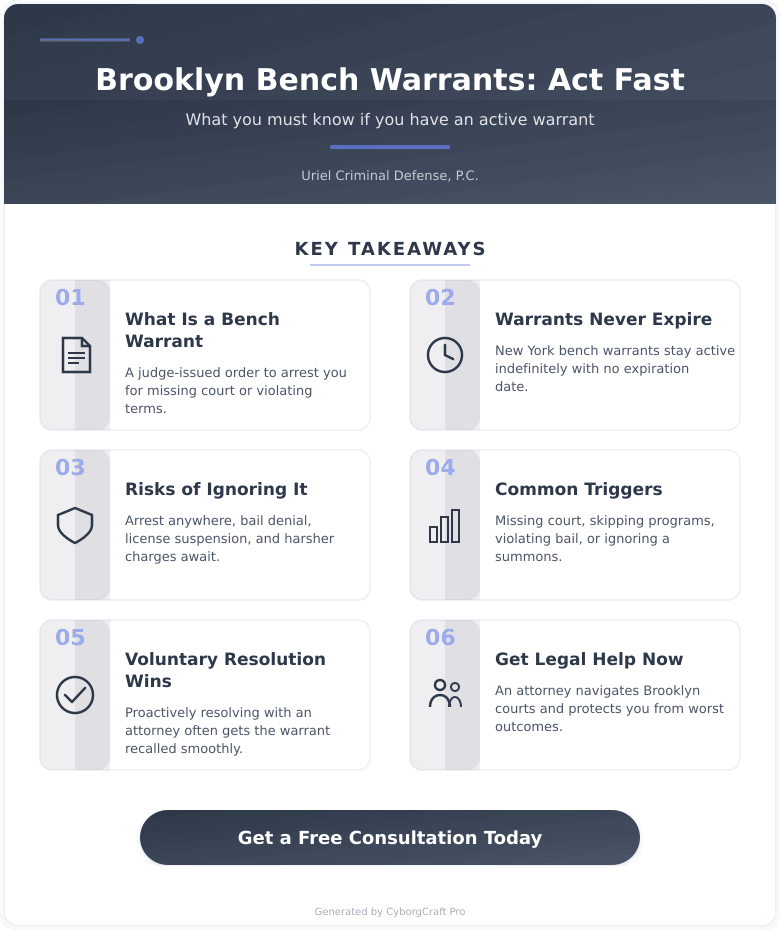
- Step 5 - Appear at every court date: Missing a Brooklyn Criminal Court or Family Court date related to an active order almost always makes things worse. Bench warrants issue quickly and can result in immediate arrest.
- Step 6 - Request modification if needed: If the order prevents contact with your children or access to your home, you can formally petition the court for a modification. This requires a legal motion and a hearing.
Documents to Prepare Before Your Consultation
- ☐ The signed order of protection with the court stamp and expiration date
- ☐ Any prior orders of protection from the same party
- ☐ Police report from the incident, if available
- ☐ Text messages, emails, or voicemails relevant to the allegations
- ☐ Names and contact information for potential witnesses
- ☐ Lease or mortgage documents if the shared residence is affected
- ☐ Any firearms registration documents if surrender is required
Common Mistakes That Make Things Worse
Recent data shows that a significant percentage of order of protection violations in New York involve the respondent - not initiating contact, but responding to contact from the protected party. Courts treat both equally as violations.
The top mistakes respondents make in Brooklyn:
- Responding to texts or calls from the protected party, believing mutual contact cancels the restriction
- Showing up to a shared property without a formal police escort or court authorization
- Posting about the situation on social media, which creates evidence against you
- Missing a court date because the order "seems minor"
- Assuming the order expires automatically without confirming the court's records
Each of these mistakes can convert a civil or misdemeanor matter into a criminal contempt charge - a separate offense carrying its own penalties independent of the underlying case.
See how our approach compares - visit our services page for a full overview of how Uriel Criminal Defense, P.C. handles criminal defense matters across Brooklyn and surrounding areas.
Key Takeaways for Brooklyn Residents in 2025
- Full orders restrict all contact - including third-party messages and social media, not just in-person contact
- Duration varies by charge type - misdemeanor orders run up to 5 years and felony orders up to 8 years under amended New York law
- Protected parties cannot lift the order - only a court can modify or vacate it, regardless of what the protected party tells you
- Violations are a separate criminal charge - even a good-faith mistake can result in arrest and a new case
- You have the right to a hearing - before a permanent Family Court order is issued, you can challenge the allegations with evidence
Frequently Asked Questions
What happens if I violate an order of protection in Brooklyn?
Violating an order of protection in New York is a criminal offense that can result in arrest, jail time, and a separate criminal charge for criminal contempt. Under New York Penal Law, first-degree criminal contempt for violating an order of protection is a felony. Even minor violations - like a single text message - are taken seriously by Kings County courts.
Can the person who requested the order drop it?
No - the protected party cannot unilaterally drop or suspend an order of protection in New York. Only the issuing court can modify or vacate the order. The protected party can request a modification hearing, but the judge makes the final decision.
How much does fighting an order of protection cost?
Attorney fees for contesting an order of protection in New York vary based on case complexity, whether it's in Criminal Court or Family Court, and the number of hearings required. General industry rates for criminal defense matters in Brooklyn range widely depending on case length. Uriel Criminal Defense, P.C. offers a free initial consultation to discuss your situation and options.
Can an order of protection affect my custody rights?
Yes - an order of protection that restricts contact with your children can directly impact custody and visitation arrangements. If you share children with the protected party, you can request a carve-out provision through Family Court that allows limited contact for custody exchanges while maintaining other restrictions.
How do I get an order of protection modified in New York?
You must file a formal motion with the court that issued the order and attend a modification hearing. The court will consider changed circumstances, evidence that the original basis for the order has changed, and whether modification serves the safety of the protected party.
Does an order of protection show up on a background check?
A civil order of protection from Family Court generally does not appear on a standard criminal background check, but a criminal court order tied to a conviction does. Any criminal contempt conviction for violating an order will appear as a criminal record. According to the New York State Division of Criminal Justice Services, criminal records in New York are maintained and accessible through background screening processes.
Can I return home if there's an active order of protection?
Not without court authorization if the order restricts your access to a shared residence. Your attorney can request a police-escorted property retrieval or petition for a modification that addresses living arrangements, particularly if you are the primary leaseholder.
What This Means for You Right Now
An order of protection issued by a Brooklyn court is not a formality. It carries immediate legal weight and real consequences for your housing, your relationships, and your criminal record if violated. The good news is that you have rights - including the right to challenge the order, request modifications, and present your side of the facts at a hearing.
Jacob Uriel and the team at Uriel Criminal Defense, P.C., located at 540 Court Street in Brooklyn, NY, handle criminal defense matters across New York City and surrounding areas. The firm serves clients throughout Kings County, Queens, Manhattan, the Bronx, Staten Island, and nearby communities. Consultations are available 24/7 for emergency situations.
Ready to take the next step? Contact us today for a free consultation and straight answers about your order of protection, your options, and what to do next. Call 833-733-4448. Acting quickly matters - court dates move fast and your response window is limited.