

This guide focuses specifically on New York's impaired driving charge classifications, how each one affects your license and criminal record, and what your realistic options look like in 2025.
DWI Definition: Driving While Intoxicated (DWI) in New York is a criminal offense triggered when a driver's blood alcohol concentration (BAC) reaches 0.08% or higher, or when impairment from alcohol or drugs is clearly observable to law enforcement.
New York does not treat all impaired driving charges the same way. The charge on your paperwork matters enormously - not just for fines, but for your ability to drive, pass a background check, and move forward with your life. The most common mistake people make is assuming these charges are interchangeable. They are not.
How New York Actually Classifies Impaired Driving Charges
New York uses several distinct charge levels under Vehicle and Traffic Law Section 1192. Here is what each one means:
DWAI (Driving While Ability Impaired by Alcohol): A non-criminal traffic infraction triggered at a BAC between 0.05% and 0.07%. This is the lowest tier - serious, but not a crime under New York law.
DWI (Driving While Intoxicated): A misdemeanor at BAC 0.08% or above, or when impairment is clearly evident regardless of BAC. This is a criminal charge with a permanent record.
Aggravated DWI: A more serious misdemeanor (or felony on repeat offense) triggered at BAC 0.18% or above. Penalties escalate sharply here.
DWAI-Drug or DWAI-Combined: Covers impairment from drugs or a combination of alcohol and drugs, even if BAC falls below 0.08%.
So where does "DUI" fit? Technically, New York does not use the term DUI in its statutes. You will hear it used casually - by police, the media, even some attorneys - but the legal documents will say DWI or DWAI. If someone charges you with a "DUI" in New York, they mean one of the categories above.
DWI vs. DWAI: The Comparison That Actually Matters
DWI vs. DWAI in New York - Side by Side
| Factor | DWAI (Alcohol) | DWI | Aggravated DWI |
|---|---|---|---|
| BAC Threshold | 0.05% - 0.07% | 0.08%+ | 0.18%+ |
| Criminal Charge? | No (traffic infraction) | Yes (misdemeanor) | Yes (misdemeanor/felony) |
| License Suspension | 90 days | 6 months minimum | 1 year minimum |
| Fine Range (2025) | $300 - $500 | $500 - $1,000 | $1,000 - $2,500 |
| Jail Exposure | None (first offense) | Up to 1 year | Up to 1 year (more on felony) |
| Criminal Record | No | Yes | Yes |
Where DWAI succeeds for defendants: No criminal record, shorter suspension, lower fines, no jail risk on a first offense.
Where DWAI still hurts: It still triggers a DMV record entry, can be used against you in future proceedings, and affects professional licensing in some fields.
Where DWI creates lasting damage: It produces a permanent criminal record, triggers mandatory surcharges, and can affect housing applications, employment background checks, and immigration status.
Where DWI defense matters most: Challenging the BAC result, the stop itself, or the field sobriety testing procedure can mean the difference between a misdemeanor conviction and a reduced or dismissed charge.
The verdict: Getting a DWI reduced to a DWAI is one of the most meaningful outcomes an attorney can pursue. It removes the criminal record component entirely - and that distinction follows you for life.
Thinking about this for your situation? Let's talk. Contact us for a free consultation - no pressure, just straight answers about where you stand.
What Happens to Your License After a DWI Arrest in New York
Your license situation actually splits into two separate cases the moment you are arrested. One is the criminal court case. The other is a DMV administrative proceeding - and they run on different tracks with different timelines.
According to the National Highway Traffic Safety Administration, administrative license suspension in states like New York is designed to happen fast - often before your first court date. Here is the typical sequence:
- Arrest and chemical test refusal or failure: Your license is immediately suspended at the precinct or shortly after. You receive a temporary document.
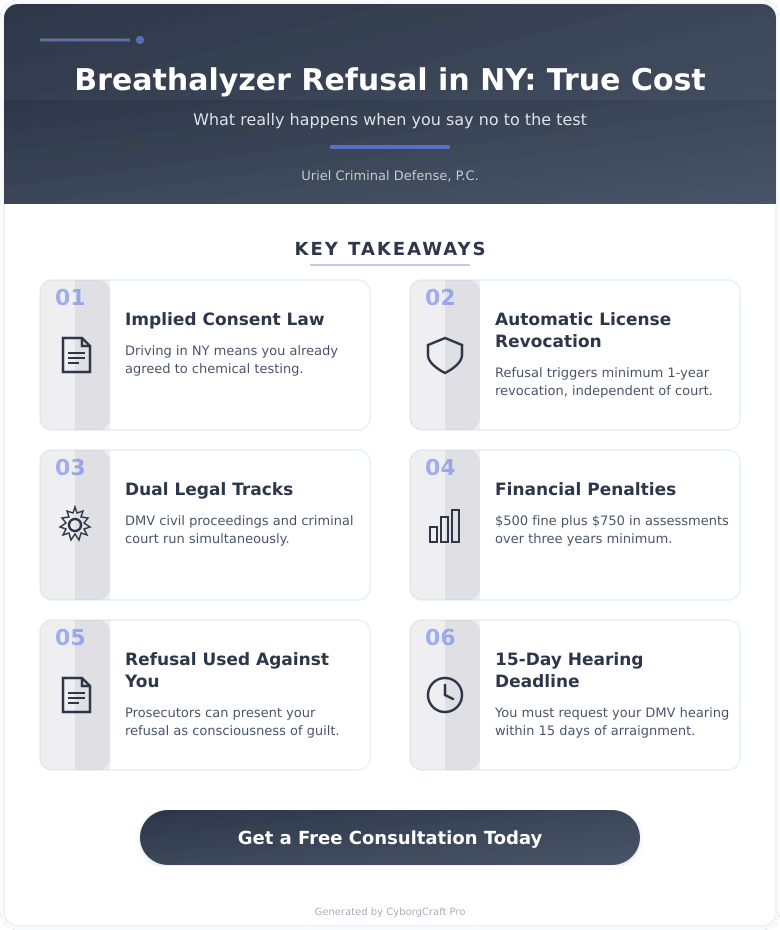
- DMV refusal hearing (within 15 days): If you refused the breathalyzer, you have a narrow window to request a hearing. Miss it and your license is revoked for at least one year automatically.
- Criminal court arraignment: A second suspension often happens here, pending resolution of the criminal case.
- Resolution: Conviction triggers the full suspension or revocation period. A dismissal or reduction may restore driving privileges sooner.
New York also requires an ignition interlock device (IID) for all DWI convictions - a breathalyzer installed in your car that you must blow into before it starts. The specific duration and conditions of the IID requirement are governed by current New York Vehicle and Traffic Law and should be reviewed with a qualified attorney. There are also financial obligations associated with IID compliance that drivers should be prepared to address.
Your DWI Defense Action Plan
- Step 1 - Request the DMV hearing immediately: You have 15 days from your arrest date. Missing this window costs you your license automatically, regardless of how your criminal case resolves.
- Step 2 - Preserve all documentation: Gather the arrest paperwork, any chemical test results, and the name and badge number of the arresting officer.
- Step 3 - Do not discuss the case: Avoid posting about the arrest on social media. Do not explain the situation to anyone other than your attorney.
- Step 4 - Get a legal review before your arraignment: Your arraignment happens fast. Walking in without counsel is one of the most common and costly mistakes defendants make.
- Step 5 - Understand your reduction options: Depending on the facts, reduction to DWAI, a plea negotiation, or dismissal based on procedural problems may all be on the table.
What to Bring to Your First Consultation
- Your arrest paperwork and any citation copies
- Chemical test results if you received them
- Your driver's license or any temporary driving permit issued at arrest
- Any court date notices you have received
- A timeline of events from your perspective, written down while memory is fresh
The most common mistake we see is people waiting too long after an arrest. The 15-day DMV hearing window is unforgiving, and the early stages of a criminal case shape everything that follows.
See how Uriel Criminal Defense, P.C. approaches these cases - and what that means for your specific situation.
Key Takeaways for New York Drivers in 2025
- "DUI" is not a New York statute - your charge will be DWAI, DWI, or Aggravated DWI, each with different consequences.
- DWAI is not a criminal offense - but DWI is, and the record it creates is permanent without expungement.
- New York has no DWI expungement - under current 2025 law, a DWI conviction stays on your record, making the initial charge outcome critical.
- Two separate proceedings run simultaneously - criminal court and DMV administrative. You need to act on both tracks.
- The 15-day DMV hearing deadline is hard - missing it has automatic consequences independent of your court case.
Frequently Asked Questions
Does New York use the term DUI in its criminal statutes?
No - New York does not have a DUI statute. The correct charges are DWAI, DWI, or Aggravated DWI under Vehicle and Traffic Law Section 1192. DUI is a colloquial term used in everyday conversation but carries no specific legal weight in New York courts.
What BAC level triggers a DWI charge in New York?
A BAC of 0.08% or higher triggers a DWI charge in New York. At 0.18% or above, the charge escalates to Aggravated DWI with significantly harsher penalties. BAC between 0.05% and 0.07% results in the lesser DWAI infraction.
Can a DWI be reduced to a DWAI in New York?
Yes, a DWI charge can be reduced to a DWAI through negotiation or successful defense challenges. This outcome removes the criminal record component entirely. Whether reduction is possible depends on the specific facts, BAC level, prior record, and the strength of the evidence.
How long does a DWI stay on your record in New York?
A DWI conviction stays on your New York criminal record permanently - New York does not offer expungement for DWI convictions as of 2025. The DMV driving record reflects the conviction for at least 10 years for insurance and licensing purposes.
What happens if you refuse the breathalyzer in New York?
Refusing a chemical test in New York triggers automatic license revocation for at least one year under the state's implied consent law. The refusal itself can also be used as evidence against you in court proceedings. A DMV hearing must be requested within 15 days to contest the refusal.
How much does a DWI attorney cost in New York?
DWI attorney fees in New York generally range from $2,500 to $10,000+ depending on case complexity, whether the case goes to trial, and the attorney's experience level. These are general industry figures - the value of legal representation often lies in the difference between a criminal conviction and a reduced or dismissed charge.
Does a DWAI show up on a background check in New York?
A DWAI is a traffic infraction, not a criminal offense, so it typically does not appear on a standard criminal background check. It does appear on your DMV driving record and may affect your insurance rates and professional licensing in certain regulated fields.
Your Next Step Starts Here
A DWI charge in New York moves fast. The DMV clock starts ticking the day you are arrested, and the decisions made in the first 15 days can shape everything that follows - your ability to drive, your criminal record, and your options going forward.
Uriel Criminal Defense, P.C. handles criminal defense cases throughout Brooklyn and the surrounding New York City area, including clients across Kings County, Queens, Manhattan, Staten Island, and the Bronx. The firm offers free consultations and is available 24/7 for emergencies.
Ready to get clear answers about your situation? Contact us today - reach us at 833-733-4448. Tell us what happened, and we will walk you through exactly where you stand.
This content is for informational purposes only and does not constitute legal advice. Every case is different. Contact a qualified criminal defense attorney to discuss your specific situation.